HOA violation tracking that survives a hearing.
A violation is not a note in a spreadsheet. It is a dated observation, a notice that went to a specific owner on a specific day, a cure period that either elapsed or did not, and — if it ever reaches a hearing or a lawyer — a record that has to stand up without anybody's memory filling the gaps.
This is how GatherAMS tracks them for a self-managed community: a fixed three-stage ladder, evidence attached to the observation rather than to an email, and the owner's own view of it in their portal.
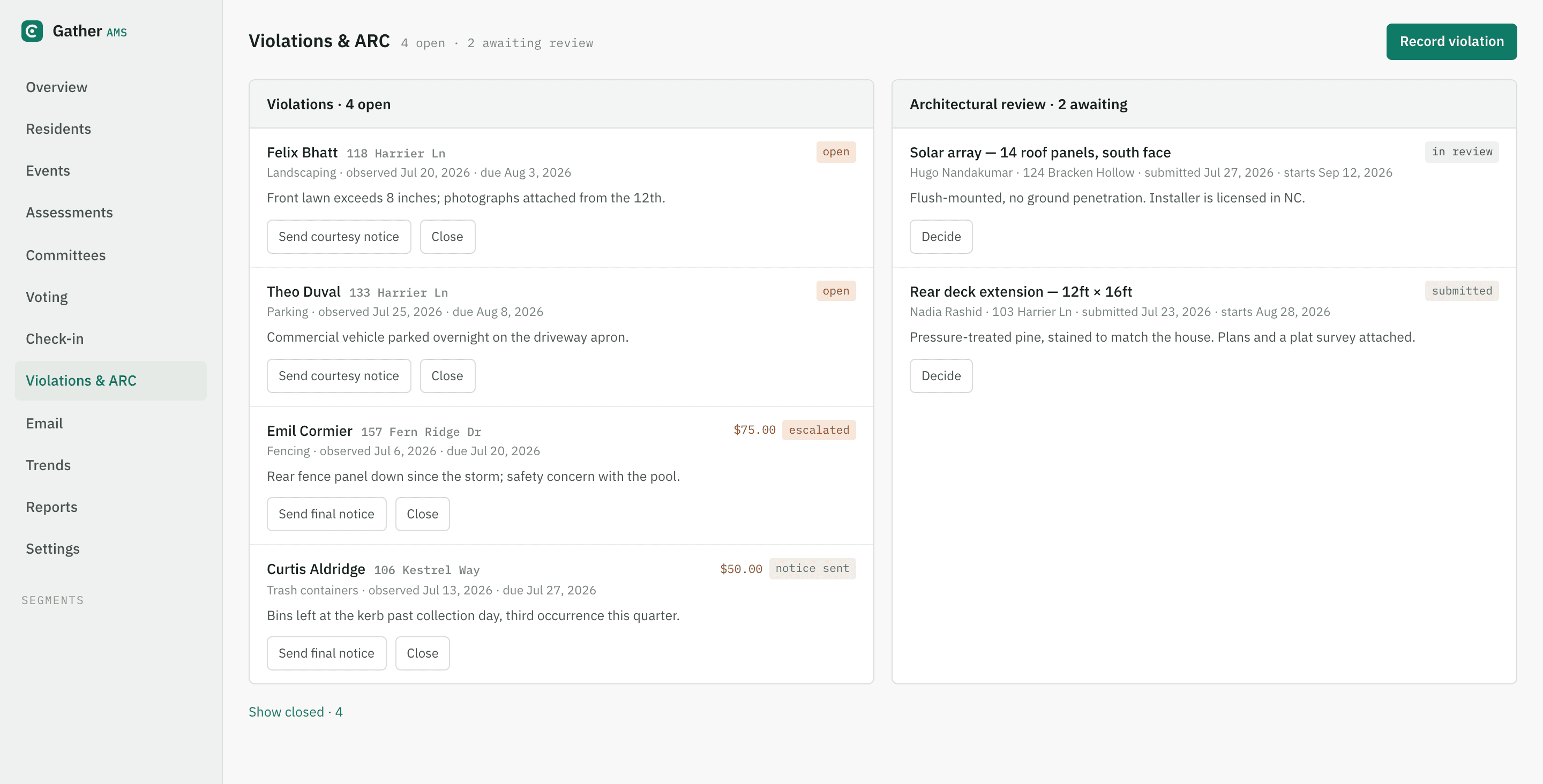
The real violations queue from the Sablewood demo — open items, cure dates, and the next notice on the ladder.
The notice ladder
Three stages, fixed rather than configurable. A board that can invent its own escalation path is a board that applies it inconsistently, and inconsistency is what loses the hearing.
- Stage 1 · 14 days to cure
Courtesy notice
Recorded against the unit, not the person, so it follows the property when it sells. The observation date, the category and any photographs are attached at this point — before anyone has written a letter — because that is the moment the evidence exists.
- Stage 2 · 10 days to cure
Formal warning
Sent only when the first cure period has actually elapsed. Each notice is written to the record with its stage, its recipient and its sent date, and a violation cannot skip a rung.
- Stage 3 · 7 days to cure
Final notice with fine
The fine is recorded against the violation and appears on the owner's account alongside their assessments, so the money and the reason for it are never in two different systems.
What makes the record hold
Evidence sits on the observation
Photographs, the date seen and the CC&R clause are attached to the violation itself. An email thread is not a record — it is one person's copy of a record, and it goes when they leave the board.
Sending twice cannot happen
The notice table carries a unique key on the violation and the stage, so a double-click or a second board member pressing send does not produce two stage-2 letters with different dates.
The owner sees the same thing you do
Their portal shows the violation, the stage, the cure date and any fine — reachable by a link, with no account to create. Most disputes are about what the owner was told and when.
Architectural review runs beside it
ARC requests use the same queue and the same evidence model, because the exterior-alteration request and the landscaping violation are usually about the same property and often the same conversation.
Questions people ask about this
How does HOA violation tracking software handle notices and cure periods for a self-managed community?
GatherAMS runs a fixed three-stage ladder: a courtesy notice with 14 days to cure, a formal warning with 10, and a final notice carrying a fine with 7. Each notice is written to the violation record with its stage, recipient and sent date, and the ladder cannot be skipped — stage 2 only becomes available once stage 1's cure period has elapsed. The stages are deliberately not configurable, because a board that can invent its own escalation applies it inconsistently, and inconsistency is what a challenged fine turns on.
Can we attach photo evidence to an HOA violation?
Yes, and it attaches to the observation rather than to a notice or an email. The photographs, the date the violation was seen, the category and the relevant CC&R clause all sit on the violation record, so the evidence exists from the moment it was observed rather than from the moment somebody wrote a letter about it.
Do owners have to create an account to see a violation notice?
No. The owner's portal opens from a link — no password to invent and no app. It shows them the violation, which stage it has reached, the cure date and any fine recorded against it, which is usually the whole of what a dispute is about.
Does violation tracking cost extra?
No. It is on every plan, from $89/month for a self-managed HOA, along with assessments, architectural review, the owner portal, email and the rest. There is no per-module pricing and no charge for support.
See this running in HOAs
A real account with real records — the screens above are from it. One field, and the link opens it on this device.
Up to 5 visits per address. We will not put you on a drip campaign — the only follow-up is one invitation to apply, and only if it looks like a fit.