Self-managed HOA software — about $15,000 a year better off.
HOA management software for boards running the community themselves: assessments on a fixed schedule with late fees, violations logged with photos, and architectural-review requests routed for approval.
Approved in a day · 30 days free, built for boards under ~300 units
kept by boards that manage without a company
assessments billed with late fees applied automatically
delinquencies, violations and ARC requests together
You are on the board, you were volunteered, and you have a day job. You are either paying a management company for work you could do yourselves, or doing it across a spreadsheet, a shared drive and your personal email.
See it running for an HOA board
These are screenshots of Sablewood Homeowners Association — a real GatherAMS account with real records in it, not mock-ups. You can open the same one yourself from a link we email you.
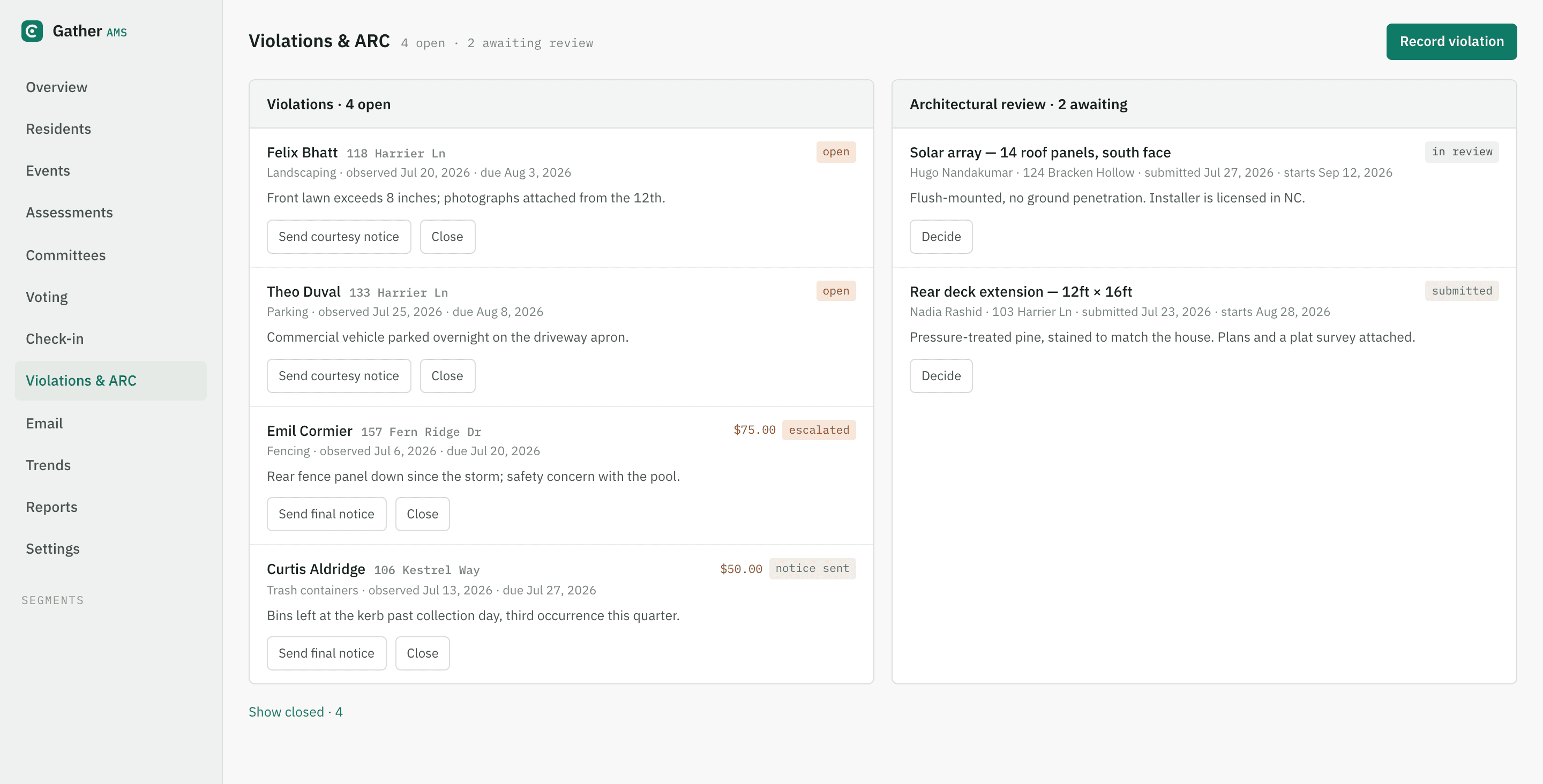
Violations and ARC, in one queue
Every open violation with its address, what was observed, when the cure is due, and which notice stage it has reached — next to the architectural requests waiting on a board decision. Courtesy notice, final notice, fine: one button each.
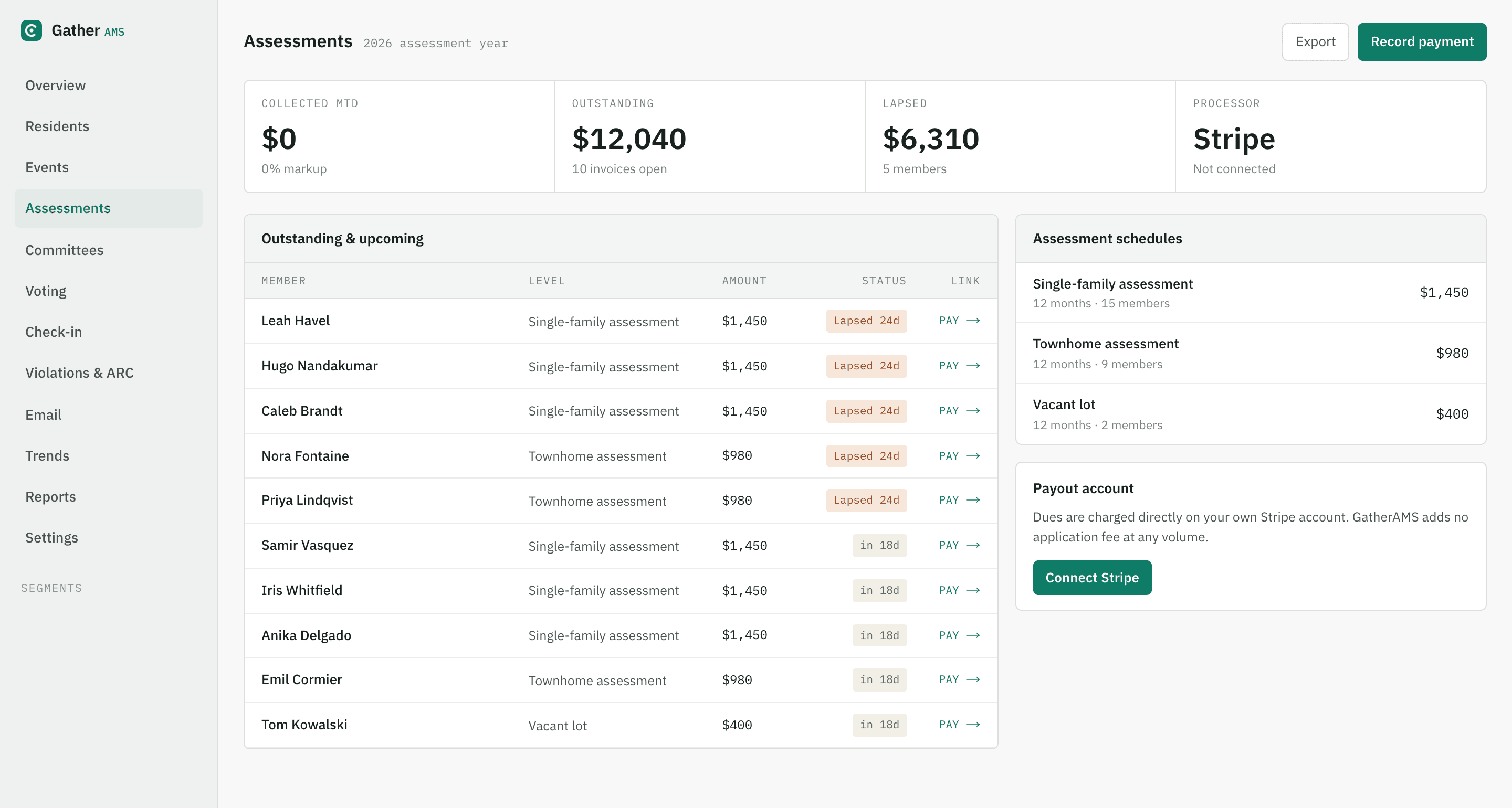
Assessments, and who is behind
Billed on schedule, late fees applied automatically past the grace period. You stop being the person who has to send the awkward reminder.
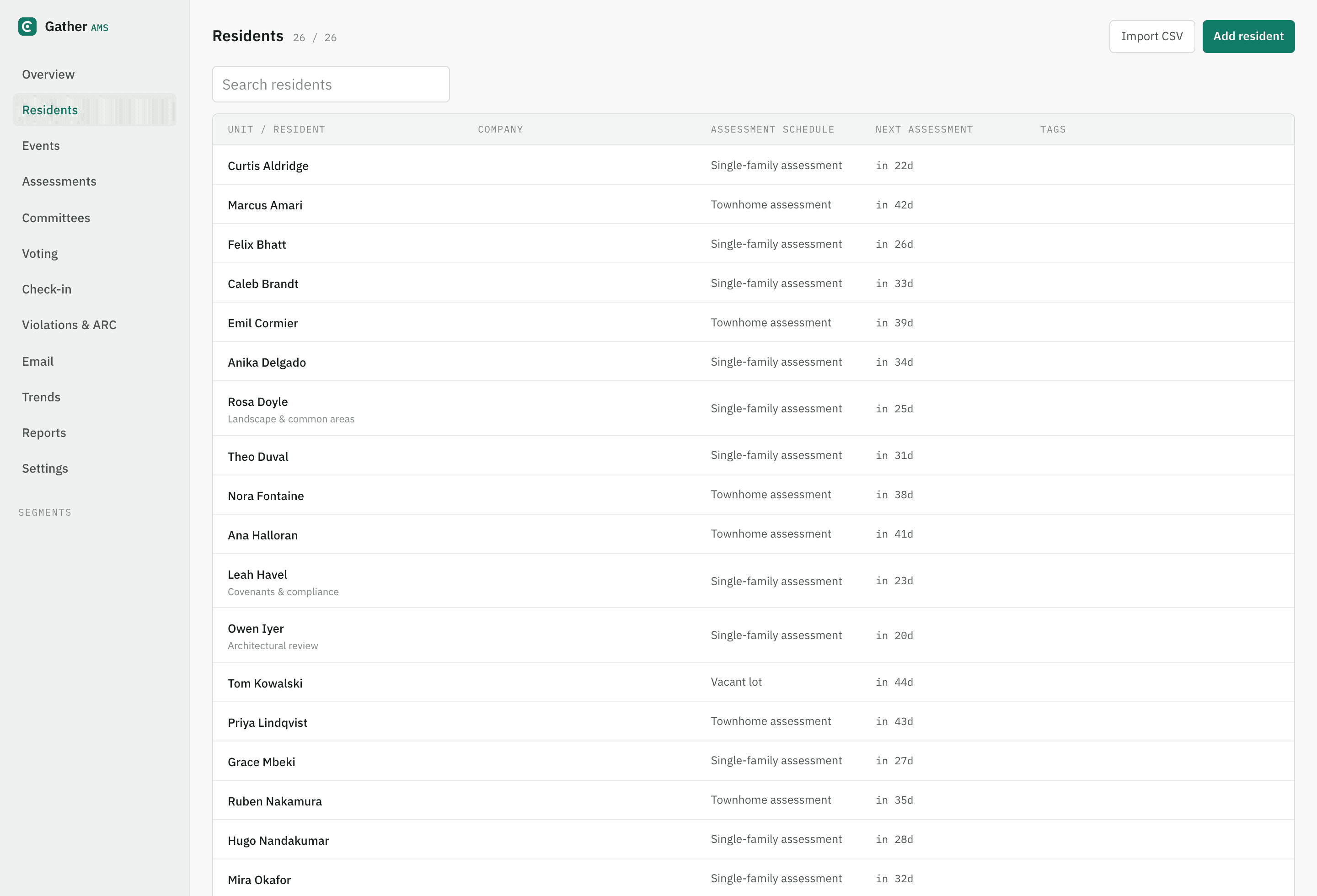
The record is the home
Address on the record, both owners on title, and their history attached — so the file on 118 Harrier Lane is one place, not three.
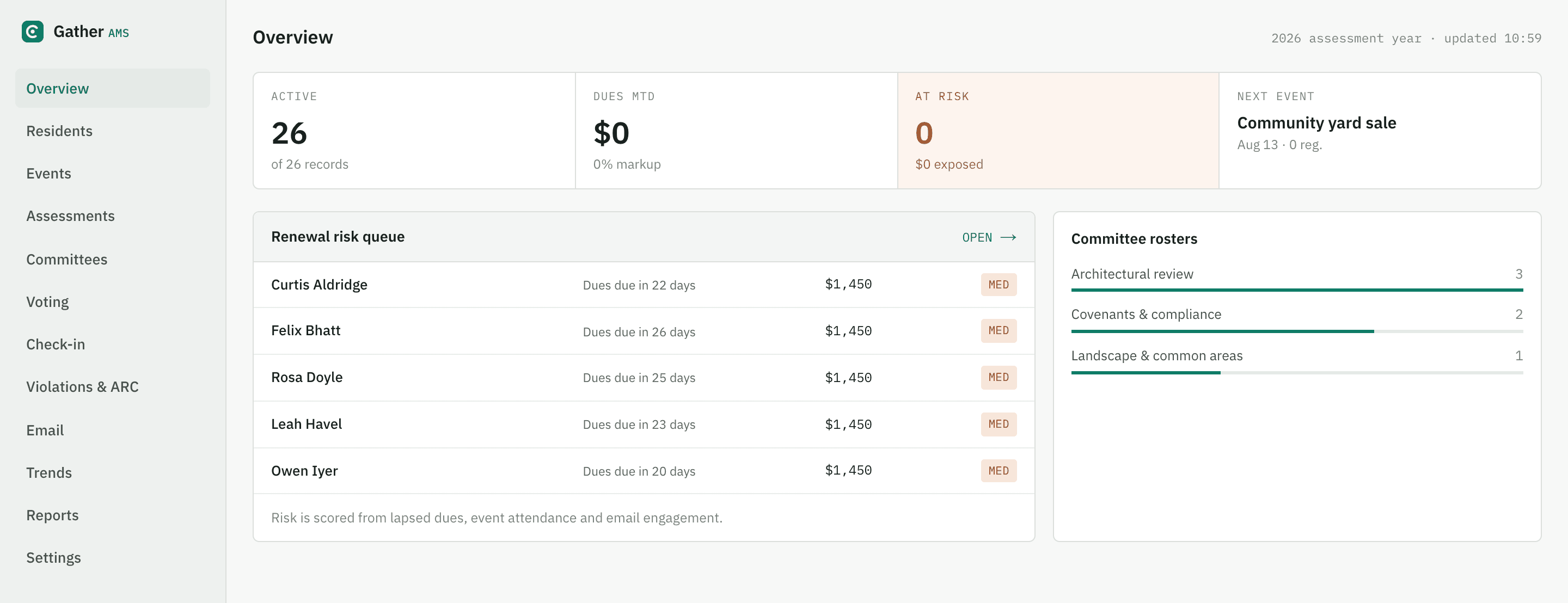
What the board actually asks
Collected, outstanding, open violations, next meeting. The answers to the four questions that come up at every meeting, on one screen.
What you're leaving behind
Roughly $15,000 a year, largely to send invoices and letters your board could send itself.
The same invoices and letters, sent by you, on a schedule. Self-managed boards keep the difference.
A template, a mail merge, and no record of which stage each home is at.
Photo evidence on the record, escalating notices, and a cure date the system tracks for you.
A request buried in someone's inbox, and a homeowner phoning to ask if anyone read it.
A queue with plans attached and a decision recorded against the home, permanently.
What HOAs turns on
Everything in the left column ships in every edition. The right column is what this flavor sets up for you.
Your first week, specifically
Not a generic onboarding checklist — the path we built for an HOA board.
The HOA page leads with the money a self-managed board keeps, not with feature lists.
Unit count and assessment cadence set the billing schedule and the words the console uses.
Your unit and owner spreadsheet becomes units with residents attached.
The checklist ends with one assessment batch billed and the document library published to residents.
Three things a management company won't hand over
The work a board actually does between meetings — chasing assessments, tracking violations, answering owners — is the work most portals keep on their side of the wall.
The unit roster, with its history
Whatever you were handed — a management company export, the previous treasurer's workbook, a folder of violation letters. Homes come in with both owners on title, the assessment ledger and any open violations still attached to the right address.
Support from people who have sat on a board
Live chat 7a–7p CT, staffed by people who have been HOA board members and self-managed treasurers. They have written the violation letter and taken the phone call after it, and they answer accordingly.
Self-managed boards usually weigh us as a PayHOA alternative. PayHOA publishes 3.5% + 50¢ per card payment; GatherAMS adds 0% on the association’s own Stripe account — on a community’s full assessment volume, that difference usually exceeds the subscription itself.
Questions people ask
How do you self-manage an HOA without a management company?
The work is mostly three loops: bill assessments and chase the late ones, enforce covenants through violations and architectural review, and keep owners informed. Self-managed HOA software runs those loops on a schedule — assessments bill themselves, late fees apply after the grace period, notices escalate on record — so a volunteer board does the deciding and the software does the sending. Boards that self-manage typically keep the roughly $15,000 a year a management company charges.
Does an HOA need a management company?
Not necessarily. A management company earns its fee on large communities and complex maintenance, but much of what boards pay for is administrative — invoices, letters, records — which software now does. The honest trade-off: self-managing saves real money and keeps decisions in the community, at the cost of board time; under roughly 300 doors with a willing board, the sums usually favour self-management.
How does HOA violation tracking work?
A violation is logged against the home with photos, a category and a cure date. Notices escalate on a record — courtesy notice, final notice, fine — and everything sent stays attached to the address, so the file on any home is one place rather than a folder of Word letters. Architectural review requests run through the same queue, with plans attached and decisions recorded permanently.
Does it handle HOA accounting?
It handles the money an HOA actually needs to track — assessments billed on schedule, payments and late fees on a ledger per home, delinquency reporting, and an export your treasurer can reconcile. Payments land on the association's own Stripe account at Stripe's own rate; GatherAMS adds no per-payment fee, which matters because some HOA platforms publish card rates above 3%.
What does HOA software cost — and is any of it free?
Per-door pricing at the established vendors runs roughly $50–$275/month by community size, plus payment fees. GatherAMS bills on contact records instead: a 320-home community with both owners on title is about 640 records, which is $89/month with everything included. Free HOA tools exist but generally cap units or charge on payments; our trial is 30 days, free, no card.
Is this HOA software for self-managed communities only?
It is HOA software for self-managed communities first: the defaults assume a volunteer board, so assessments, late fees and violation notices run on schedules rather than waiting for someone's evening. A professionally managed community can use it too, but if you already pay a management company, most of what this replaces is work you are currently buying from them.
How many homes?
Both names on the deed both get the assessment notice.
HOAs are billed on contact records, so a 320-home community with both owners on title is priced as roughly 640 contacts — still well inside a single plan.
Committees and sub-groups, saved segments, renewal-risk scoring
Apply for accessNo setup fee, no onboarding engagement, no charge for support, and no markup on payments — your processor bills you at your own rate.
Apply as an HOA board
Approved in a day · 30 days free, built for boards under ~300 units
How the parts you asked about actually work
Violation tracking for self-managed HOAs: a three-stage notice ladder with cure periods, photo evidence, ARC requests and an owner portal.
How dues and automated renewals work: level-based invoices, reminders at 30, 7 and 1 days, autopay, late fees, and 0% added to your payments.
Written for an HOA board
Free, ungated, and useful whether or not you ever use the software.
How to run an HOA without a management company: what boards actually do, the pros and cons of self-managing, and the software that replaces the admin work.
What a community association management system does, why most are built for management companies not boards, what the software costs, and how to choose.
What an HOA reserve study is, what it costs, how often to update it, and how percent funded actually works — explained for volunteer boards, not accountants.